
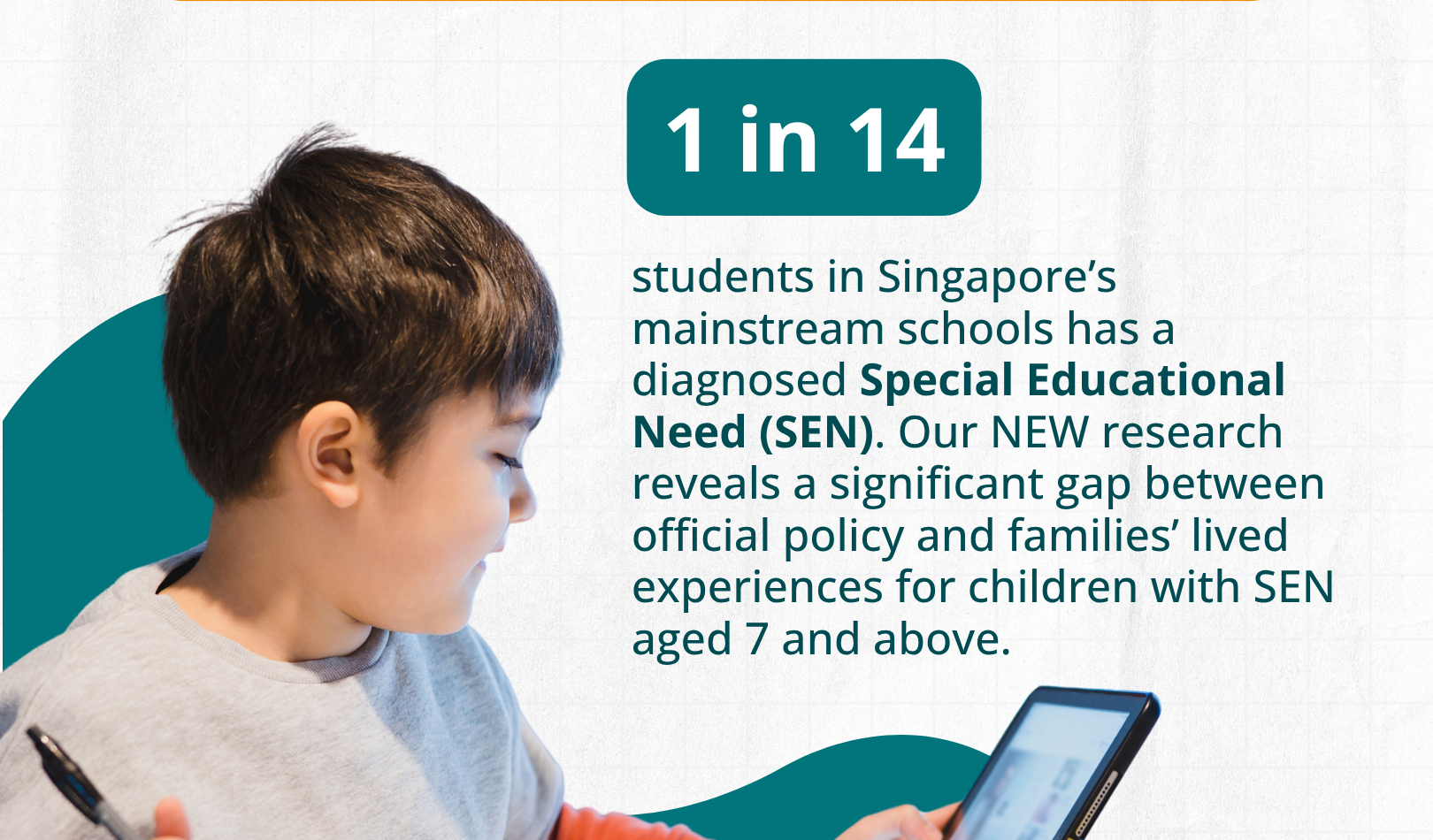
EveryChild.SG is recommending enhanced support for children with Special Educational Needs (SEN) from both the healthcare and mainstream education systems, following a survey of 71 parents that revealed service gaps for children with SEN aged 7+, and widespread confusion, financial stress, and emotional distress for parents.
Seven percent of students in MOE mainstream schools have been diagnosed with SEN – which can include dyslexia, dyspraxia, attention deficit hyperactivity disorder (ADHD), autism spectrum disorders (ASD), and physical/ sensory impairments. Students with SEN come from the entire range of academic ability, including some with exceptional ability in certain areas. Behind every data point is a child whose future potential depends on the support they receive during their schooling years.
Following significant anecdotal feedback on the challenges faced by parents of students with SEN, EveryChild.SG surveyed 71 parents of primary school-aged students with SEN for our report, “Mind the Gap: Navigating SEN Diagnosis and Support for Primary School Children in Singapore.” Combined with in-depth interviews of parents and paediatric professionals, our findings indicate a significant gap between SEN support as it exists “on paper” and as it is actually experienced by families. In particular, EveryChild.SG found:
A. Confusion and fragmentation characterises the public healthcare support system for children with SEN. 53% of families seeking SEN assessment (for children aged 7 and above) via the public healthcare system report confusion, fragmented/unclear processes, or “referral loops”, compared to only 18% in the private healthcare system.
B. A two-speed healthcare system delays assessment and intervention for less-privileged children. The average waiting time for SEN assessment and diagnosis (for children aged 7 and above) within public healthcare institutions ranges between 6 and 18 months, compared to 1–3 months for those who utilize the private system.
C. School-based support is highly prized, but can be difficult to access. Many parents report that it is difficult for their child to access SEN support in their primary schools. Of those with a formal SEN diagnosis, 31% reported receiving no school-based support at all. 50% received some form of SEN officer support, including 15% who met with the SEN officer weekly. For most diagnosed children, SEN officer support is infrequent and reactive. There is a widespread perception among parents that a triage model limits SEN officer support only to the most “disruptive” students. Receiving SEN officer support increases parents’ satisfaction with the school.
D. There is a lack of clear, public-facing policy governing SEN support in schools. Interviewed parents often feel that the quality of their child’s education depends on individual SEN officers and school they attend, rather than on a well-considered public policy.
E. Dismissive attitudes delay diagnosis and downplay the need for support. 35% of parents experienced dismissiveness from teachers and other school-based support staff when they raised concerns about their child’s potential learning needs. 72% of those experiencing dismissiveness eventually obtained a formal medical/ clinical diagnosis for their child. Among all respondents with a diagnosis, 1 in 3 still report experiences of dismissiveness even after the diagnosis — particularly from educators, general practitioners, or non-specialist paediatricians.
F. Caregiver burden is largely unaddressed. Over 60% of parents describe navigating the system as emotionally draining. Parental stress, burnout, and even marital strain or isolation are regularly cited as a fallout from this process.
Key Recommendations
To enhance support for children with SEN, EveryChild.SG recommends:
Diagnosis:
- Articulate clear processes and provide accessible diagnosis and support services in the public healthcare system for children above 7.
Support Professionals & Training in schools:
- Increase staffing (including smaller class sizes), improve training of SEN officers and teachers, and their sensitivity towards children, and provide clearer communication to parents on SEN support roles in schools.
- Provide schools with regular, in-school access to Allied Health and Education Professionals (i.e. licensed Occupational Therapists, Speech Therapists and psychologists) beyond SEN officers.
Inclusion Policies in schools:
- Improve differentiated instruction and scaffolding for ALL learners (including by making PSLE optional).
- Issue clear, consistent guidance and adequate resourcing for individual education plans (IEPs) and access accommodations in schools, granting students all medically/ clinically-recommended accommodations in order to maximise their learning.
These improvements in standards and resourcing will benefit not just students with SEN, but ALL students in our primary schools. Smaller, well-supported classrooms allow teachers to nurture every child, regardless of learning style, social-emotional needs, or temporary challenges like illness or family disruptions. A better-resourced and more inclusive approach strengthens the overall resilience, empathy, and adaptability of the classroom community, and allows teachers to nurture better 21st Century Competencies across the board.
EveryChild.SG also reiterates its call for making child well-being a national priority.With responsibility for children currently spread across 4 Ministries and multiple agencies, even dedicated professionals can struggle to act quickly and consistently. No one wants a child to slip through the cracks — but cracks appear when accountability is diffuse.
Having one clear national-level policy lead for children can help ensure that referral processes and support services for children are clear, consistent, well-resourced, accessible and affordable.
ACCESS our Complete SEN Report 2025 here


