Megan would have been 10 years old this year.
In the wake of the Independent Review Panel on the Megan case, one truth is impossible to ignore:
When responsibility for children is spread across multiple agencies, even dedicated professionals can struggle to act quickly and consistently. No one wants a child to slip through the cracks — but cracks appear when accountability is diffuse.
The Independent Review Panel (IRP) into Megan’s death found delays, diffuse responsibility, and slow multi-agency coordination — problems no single professional could fix alone. We honour Megan’s memory by fixing the system so that every child is seen early, clearly, and consistently.
MSF’s announcement (in response to the IRP) that it would set up a social services coordination centre is a good first step. But there are many other complex and multi-faceted issues, besides child protection, that children and their caregivers are struggling with.
EveryChild.SG has three mutually reinforcing recommendations to close those cracks for good:
1. One clear national lead for children and young persons (CYP), from birth (including prenatal) to 18 (and 21 for children with special needs).
2. One front door, i.e. an “AIC for Children” — a national coordination hub, like the Agency for Integrated Care (AIC) for seniors, that makes help for CYP easier to find, easier to access, and faster to deliver.
3. Common standards & capability building (the glue) — Let’s establish clearly articulated evidence-based, child-development-aligned guidelines for everyone who interacts with children and young persons — caregivers (parents, grandparents, helpers), teachers (preschool, school, enrichment), student-care staff, social workers, youth workers, the medical system, police, MINDEF, the justice system — and train to those standards consistently.
Why this can’t wait
🚨 Mental health red flags: 1 in 3 youths aged 15-35 report severe symptoms of stress, anxiety, or depression—yet only about 1 in 10 parents can recognise the signs.
🚨 Lives at stake: On average, one child dies by suicide every 10 days.
🚨 Structural fragmentation: Four ministries (MOE, MOH, MSF, MCCY) touch different parts of a CYP’s life, with different KPIs and practices. That leads to inconsistent stances (e.g., on corporal punishment) and service gaps (e.g., parents of children with special educational needs who often get lost toggling between the MOH and MOE systems).
🚨 Stretched frontline systems: Professionals across schools, healthcare, and social services are doing their best within split-mandate systems with unclear hand-offs and slow multi-agency referrals — precisely the conditions highlighted by the IRP.
🚨 Delays in tackling emerging issues and trends, e.g.:
- To parents, it was obvious that the vaping epidemic in schools was at least 2 years in the making.
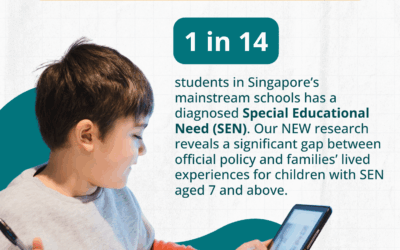
- Despite a known trend of increasing developmental needs diagnoses dating back at least a decade or more, expansion of Special Education and support systems in mainstream schools has not kept up.
- PSLE remains the main KPI of primary school education, even though the needs of our economy have moved much beyond the industrial age that the PSLE was designed for.
And yet, it bears repeating, this is not the fault of any one single agency or profession. Singapore doesn’t lack care or commitment — we lack a system that makes quick, coordinated, child-centric action the default.
Recommendation 1: One clear national lead for children
We request PM and the Cabinet to designate clear national leadership — a Coordinating Minister, an Independent Commissioner, or a high-level Taskforce — for Children and Young Persons (CYP), with the mandate to:
- Set shared goals and outcomes for the well-being, support and safety of CYP, across government agencies and the social sector;
- Ensure rapid cross-agency collaboration and action when risks escalate;
- Track system performance transparently — from referrals to outcomes — and fix bottlenecks quickly.
In practice, this means:
- One budget, one decision-maker: A pooled, cross-agency CYP budget controlled by the national lead, who funds interventions based on whole-of-life value (across education, health, mental health, justice, employment), rather than which ministry bears the intervention cost.
- Mandate: Legal/ administrative authority to set cross-agency KPIs, standards and protocols for CYP risk and well-being;
- Powers: Ability to trigger time-bound responses and require agencies to deploy staff and share data;
- Transparency: Regular publication of system metrics — e.g. referral-to-first-contact, assessment wait, therapy start, relapse/case re-entry — so the public can see progress.
When everyone knows who is ultimately responsible, urgent decisions get made, accountability is shared, and help arrives sooner.
Recommendation 2: Create an “AIC for Children”
Not more bureaucracy — one front door, fewer hand-offs, fairer access.
Centralised intake/coordination reduces duplication and improves parity, so support doesn’t depend on a parent’s or caseworker’s awareness or ability to push through a confusing system.
Over a decade ago, Singapore started re-engineering the care system for an ageing population, consolidating AIC as the agency to help seniors navigate healthcare and community support. Children and their families deserve the same navigational power.
What an AIC for Children would do:
- One front door, zero guesswork: A single, easy path for parents, teachers, doctors, and social workers to refer a child — without guessing which agency to call. No more siloes between child protection, education, health, mental health, disability, out-of-home care, etc.
- Consistent help, whatever the need: A clearer, more consistent and linked-up system of referrals, diagnosis, intervention, school/ classroom accommodations, and parent training/ support for children — of all ages — facing: 1) Learning or developmental challenges; 2) Emotional or behavioural issues; 3) Family-based stresses (ranging from the temporary, such as the death of a parent, to more entrenched issues such as poverty or domestic violence/ abuse); 4) Out-of-home care, including adoption, foster care and institutional homes.
- Fast triage & warm hand-offs: Manned by a multidisciplinary team that can assess need, assign case leads, and coordinate across schools, healthcare, social services, and the courts as necessary.
- Equitable access: Reduce wait times and close service gaps (e.g., it’s time we have accessible therapy services for children over seven years of age, and home-based support for severely disabled children, at least as good as what seniors can receive). Let’s design for equity from day one: prioritise children with complex needs, and ensure fees, distance and caregiver awareness/ capabilities never block access.
- Data with teeth: System-wide visibility of waitlists, time-to-help, and outcomes — so funding, manpower and capability building can follow real needs, and bottlenecks are fixed.
Recommendation 3: Common standards & capability building (the glue)
A national lead and a coordination hub need shared practice standards. Let’s establish clearly articulated evidence-based, child-development-aligned guidelines for everyone who interacts with children and young persons — caregivers (parents, grandparents, helpers), teachers (preschool, school, enrichment), student-care staff, social workers, youth workers, the medical system, police, MINDEF, the justice system — and train to those standards consistently.
For instance, currently, MOE’s school-based caning policies and MSF’s protection-from-harm guidance publicly diverge on physical punishment, sending mixed signals to adults. Common, child-development-aligned standards would give consistent guidance across settings.
We’ve made a start with e.g. the parent resources on Grow Well SG, but we need to go much deeper, and try to reach all parents and professionals working with CYP.
With clear common standards and capability building across the board, children can get consistent, nurturing responses wherever they are — home, school, clinic, or community.
What success could look like in the first 12–18 months (after launch)
Target metrics could include, for e.g.:
- 5-day rule: First contact within 7 calendar days of referral (24–48 hours for high-risk).
- Wait-time halved: Median time from referral to start of intervention cut by 50%.
- Named lead: 100% of complex cases have a named case lead within 7 calendar days.
- No drop-offs: ≥95% of missed appointments receive outreach (call/SMS + reschedule offer) within 48 hours; ≤3% of open cases go >30 days with no recorded contact despite scheduled milestones.
- Parent navigation: 90% of parents report they “know who to call” after first contact.
Quick FAQs
Isn’t this MSF’s job?
No — nurturing the holistic development of all our children goes much beyond both the responsibility and the resources of any one Ministry currently. Hence our proposal to give one empowered lead the mandate and tools to align (or even revamp parts of) MSF, MOE, MOH, MCCY and the juvenile justice system around shared child outcomes.
Isn’t this expensive?
No — early, coordinated help costs less than crisis care, saving both lives and money. A single national lead can make whole-of-life investment decisions using a pooled CYP budget, so Singapore funds what delivers the greatest lifetime value (higher school completion and employment; lower acute healthcare, crime, addiction and suicide). Net effect: lower lifetime public costs and a stronger economy.
EveryChild.SG’s ask
Singapore has the talent, resources, and will. What’s been missing is a system designed around the child. Let’s:
- Establish one clear national lead for children;
- Build an AIC for Children to coordinate, navigate, and deliver;
- Adopt common, evidence-based standards and upskill every adult who works with children.
After Megan, “never again” must be more than words. Let’s make child well-being a national priority — backed by structure, standards, and leadership that sees every child, early and clearly.